Moving to the Triangle comes with a bit of a learning curve. Not because the area is especially difficult to understand, but because locals tend to speak in geographic shorthand and assume everyone already knows what they mean. Someone will casually mention that they live near Falls, work in RTP, avoid Capital at rush hour, and spend weekends ITB. You may smile, nod, and have absolutely no idea what they just said.
Consider this your unofficial Triangle translation guide.
"The Triangle"
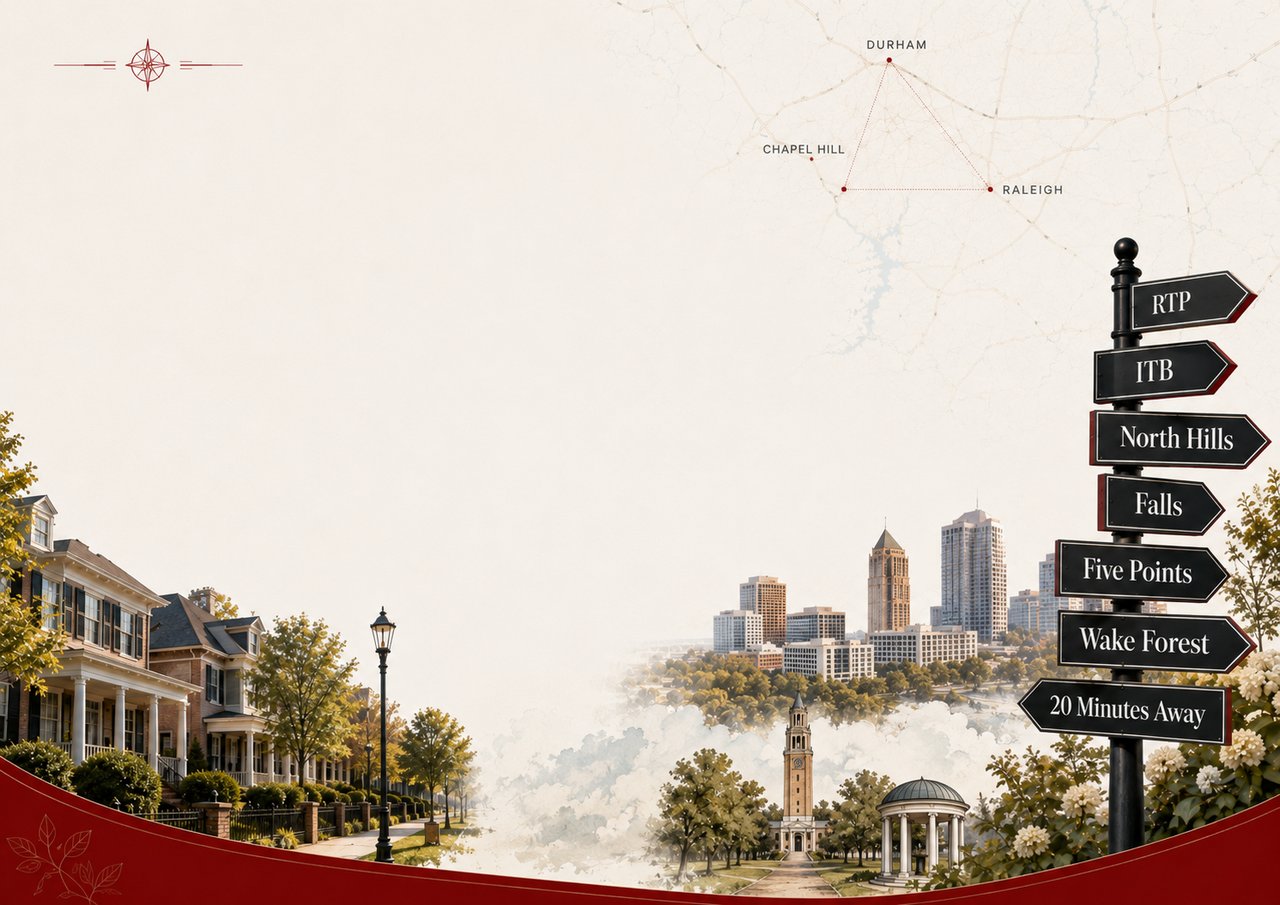
Let’s begin with the obvious one. The Triangle generally refers to Raleigh, Durham, and Chapel Hill, named for the three major research universities that helped shape the region: NC State, Duke, and UNC-Chapel Hill. Simple enough—except people also use “the Triangle” to include Cary, Apex, Morrisville, Wake Forest, Hillsborough, Pittsboro, Holly Springs, Fuquay-Varina, Garner, and sometimes anywhere within a reasonably optimistic drive of Interstate 40. The Triangle is less of a precise geometric shape and more of a general feeling.
“RTP”
RTP stands for Research Triangle Park, one of the area’s largest employment centers. Newcomers sometimes assume it is a town, but there is no charming RTP downtown where everyone gathers on Saturday mornings. It is a large business and research park located between Raleigh, Durham, and Chapel Hill. When someone says they work in RTP, that still leaves one fairly important question unanswered: which side? Depending on the answer, the commute could be pleasantly manageable or a daily opportunity for quiet reflection.
“Inside the Beltline”
Inside the Beltline, commonly shortened to ITB, generally means the part of Raleigh located inside Interstate 440. It is part geographic description and part real estate term. People may use it to describe older neighborhoods, established trees, historic homes, shorter drives to downtown, and the ability to hold very strong opinions about where Midtown actually begins. Outside the Beltline is sometimes called OTB. Neither is automatically better—they simply offer different home styles, lot sizes, commute patterns, and levels of emotional attachment to traffic circles.
“North Hills”
North Hills is not just a neighborhood. It is also a shopping district, dining destination, office center, entertainment area, apartment hub, and a place where you may accidentally spend an entire Saturday. Someone may say they live “near North Hills,” which could mean they can walk there. It could also mean they live fifteen minutes away under perfect traffic conditions and have decided that still counts. This is perfectly normal Triangle geography.
“Falls”
When someone says they live near “Falls,” they probably mean Falls of Neuse Road. Probably. They could also mean Falls Lake, Falls River, Falls Village, Falls Pointe, or one of several neighborhoods whose names strongly suggest that water must be nearby. Falls of Neuse Road is long, busy, and important enough that locals shorten it as though everyone has already received the briefing. You have now received the briefing.
“Wake Forest”
Wake Forest is a town north of Raleigh. Wake Forest University is in Winston-Salem. These two things are not located together. This confuses nearly everyone at first and continues to confuse people long after they technically know better. The university began in the town of Wake Forest before moving to Winston-Salem in the 1950s. The town kept the name, the university kept the name, and newcomers inherited the confusion.
“Downtown”
When someone says, “We’re going downtown,” it is now perfectly reasonable to ask which one. Raleigh? Durham? Cary? Chapel Hill? Possibly Apex? The Triangle has collected quite a few downtowns, and several of them are determined to make sure you do not underestimate them. Downtown Cary is a particularly good example. People who have not visited recently may still picture a few quiet streets surrounded by suburban neighborhoods, but the area now has restaurants, breweries, shops, events, public art, and a major downtown park that has quickly become a popular gathering place.
“The Village District”
The Village District is the shopping area formerly known as Cameron Village. Many longtime locals still call it Cameron Village, while others use the new name. Learn both names, respond confidently either way, and no one will question you.
“Five Points”
Five Points is a historic area near downtown Raleigh where several roads come together. It includes older neighborhoods, restaurants, local businesses, and intersections that may cause you to question whether you are still traveling in the direction you intended.
“It’s About 20 Minutes Away”
This may be the Triangle’s most frequently used phrase. Nearly everything is described as being about twenty minutes away. Downtown Raleigh? Twenty minutes. The airport? Twenty minutes. Durham? Twenty minutes. A restaurant on the opposite side of town during Friday rush hour? Somehow, still twenty minutes. Actual travel time depends on the road, the hour, construction, school traffic, weather, and whether something unfortunate has happened on I-40. Triangle residents do not measure distance in miles. We measure it in optimistic driving estimates.
“The Fairgrounds”
This usually refers to the North Carolina State Fairgrounds in Raleigh. Even when the State Fair is not happening, the fairgrounds host markets, shows, competitions, festivals, and enough other events to affect traffic in the surrounding area. During the State Fair, however, “near the fairgrounds” becomes less of a location and more of a warning.
“Which Team Do You Pull For?”
This is not casual small talk. Choose your next words carefully. UNC, Duke, and NC State rivalries are deeply woven into Triangle culture. Team loyalty may come from family history, college attendance, childhood experiences, marriage, or one basketball game decades ago that someone has never emotionally recovered from. Saying that you do not follow college sports may be accepted—but probably only temporarily. Eventually, someone will attempt to recruit you.
You’ll Be Speaking Triangle Soon Enough
At first, the Triangle can feel like a collection of overlapping cities, highway numbers, neighborhood nicknames, changing district names, flexible boundaries, and extremely serious college loyalties. Then, without realizing it, you will start giving directions using landmarks that no longer exist. You will describe three completely different places as “about twenty minutes away.” You will develop a preferred route to the airport. And one day, a newcomer will ask what RTP means, and you will answer as though it has always been obvious.
Whether you are moving to the Triangle for the first time or simply relocating from one side of it to another, choosing the right area involves more than finding a house with the correct number of bedrooms. Commutes, communities, lifestyles, and even local terminology can make a big difference. I’m always happy to help you make sense of the options—and find the part of the Triangle that feels right for you.
No translation guide required.